Showing posts with label animals. Show all posts

Friday, June 13, 2014

I live for the Macaws, Macaws, Macaws.


What did the spider monkey say to the macaw? Not sure, but whatever it was, the macaw is pissed off. Watching these two provided endless entertainment. They are both pets sharing a jungle home at the Monte Amazonico lodge, on the banks of the Madre de Dios river in Peru. I use the word "share" lightly. In truth, the Macaw is probably the most territorial pet I have ever seen. Every day, it attacked at least one unsuspecting guest who was dozing in her hammock. What made it even creepier was the way it squacked "Hola! Hello!" before snapping with its beak.

The spider monkey, Marukha, knew that the macaw was a persnickety soul and delighted in teasing it. It would swing by and grab the macaw's tail, and then dangle just out of reach of the macaw's beak. It stole a cracker that the guests had thrown out for the macaw. It stole my glasses once. It stole just about anything it could get its hands on, really, and it stole our attention whenever we were done with our jungle adventuring.

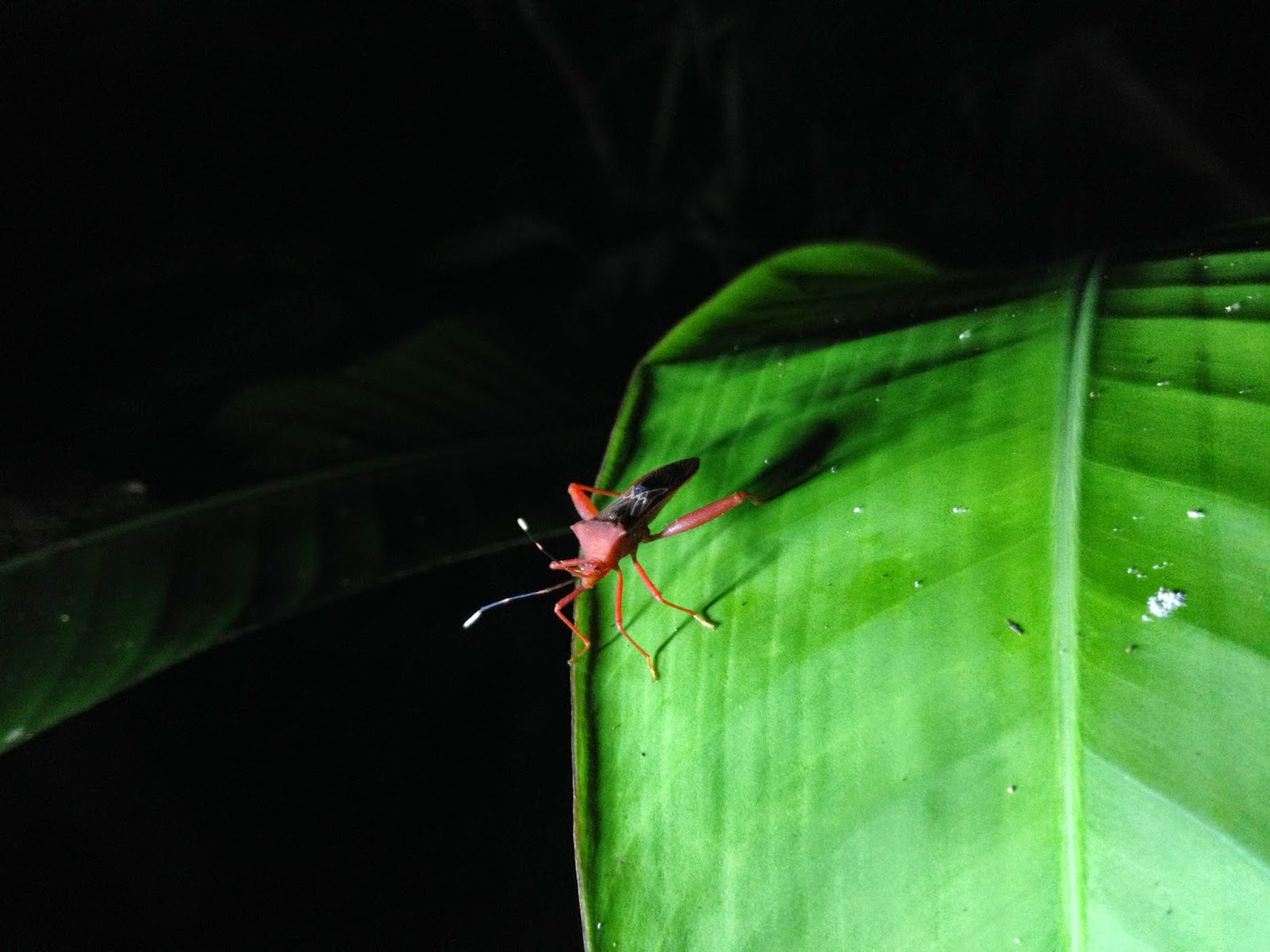

The jungle here was secondary growth forest, meaning that it had been deforested in the past, but there was plenty of flora and fauna to keep us busy. We spotted caiman, capybara, howler monkeys, tarantulas, tree frogs, snakes, hoatzin, river otters, herons, bats, enormous ants, and so many butterflies that we literally had to swat them away.

It was a surprisingly comfortable and relaxing place to be. Before coming I had feared that we would be sweltering hot, sweating through our sheets at night and devoured by the mosquitoes. We slept well, with the forest breeze wafting over us through the screen. At night, the animals didn't make as much noise as the cicadas sometimes do in the U.S. With refreshing juices at lunch, like starfruit and passion fruit and cupuazú (a fun Amazon jungle fruit), I had more energy to tackle the challenges the lodge threw at us.


Like ziplining in the canopy!  Much scarier than I thought it would be.  And kayaking, fishing for piranhas (Josh caught one using the most rudimentary fishing line you've ever seen), hiking through a 3km mud trail to an oxbow lake, and of course surviving the terrifying macaw.


On our last day, we took a break from animals and went to visit humans.  The Mashinega family, who now farm and live on the river bank.  They were marketed to us as a native family, but I asked the grandfather if he was born there, and he said no, so I'm pretty sure that disqualifies them... No matter, though, because it was really interesting to hear and see the things they were doing to make themselves seem more "native" to us.  Like putting achiote (red plant dye) on their faces, singing and dancing with drums, shooting arrows, and the like.  The grandmother was the only one singing, presumably because she was the only one who still knew any songs.  I knew it would be cheesy.  The thing that struck me was how earnestly the grandfather was getting into it.  And the kids loved it.  So, in the spirit of cultural exchange, and sharing, we reciprocated.  Josh and I sang "Take Me Out to the Ballgame" for them.  Of course both sides were putting on a show, and what stayed with me is how fun it was for all of us.


For all our exploring, we only saw the tiniest sliver of the forest around the river.  We both think the Amazon seems like an incredibly diverse place worth exploring further.  Going up one of the tributaries, farther away from the cities and logging operations, would be really dangerous but probably full of surprises.  We've caught jungle fever, so watch out.  We may be in the market to buy a boat if you're selling...

Saturday, May 31, 2014

Sitting on the dock of Iquique

Our detour around Bolivia took us to the (completely unfamiliar to me) north coast of Chile.  I don't know why, but I was expecting something Mediterranean.  But no, as we were landing in the town of Iquique, we pulled down the airplane window shade and saw a vast desert stretching away as far as the Andes.  Then all of a sudden the word "Atacama" came back to me from geography bees past.  We were in the driest place on Earth.


In Iquique, it turns out, the whole reason for the city to exist was mining.  The big sandy hills that surround the city are full of minerals like nitrates and saltpeter - minerals valuable enough that Chile went to war with Peru over them in the 1800s. The area was full of small mining towns until they were gradually abandoned in the mid-1900s, leaving giant refineries abandoned in the desert. We heard that there was a particularly well preserved ghost town just 40 km east of us.  The place was a saltpeter mine until it was abandoned in the 1960s and now it is even a UNESCO world heritage site.  It is called Humberstone, which the people here pronounce like "Ombertun." 

Our misadventure trying to visit Humberstone need not be recounted in detail.  Let's just say, due to traffic, it took us an hour to go 5 kilometers of the way there before we decided to get out of the car and turn back so that we could catch our onward bus.  We were annoyed that we couldn't make it in time, but later found out there were several earthquakes last month (around 8 on the Richter scale!) that badly damaged the highway out of town.  I felt sheepish for complaining about the traffic when I found that out.

But still, we wanted to do something before leaving.  The tourist information office recommended an hour boat trip out past the harbor.  But lo and behold, when we got there, no boats were running.  Just our luck, right? 


Dejected, we went to the dock to look at the water.  There was some kind of huge brown bean bag on the dock.  As we got closer, it opened a sleepy eye and watched us.  A sea lion?!  Was this really a lone sea lion, sitting fat and sassy on the dock of the bay?  They live in colonies, so it made us wonder why this one was alone.  Maybe he was taking a break from the group, or maybe he had been kicked out.  He seemed pretty content either way, and his serene smile made us feel better about the failed Humberstone and Boat trips.


Sitting there ended up being lovely.  Out in the ocean, the most enormous waves I have ever seen crashed against the distant breakers.  The little sandy beach was strewn with tons of large, intact mollusk shells.  A black bird with a long red beak stalked the surf, while men stood on boulders fishing for whatever could withstand that tide.  We left Iquique wishing we had stayed longer.  I know so little about the Atacama region, but what little I know says there is a lot going for this little mining town.

Thursday, May 8, 2014

Monkey see, monkey do

I.  Monkey see


Meet Dinkinesh.  She lives in the Ethiopian national museum.  In the English world, we call her "Lucy," but who knows what name she actually went by.  It was so long ago, and all we have are these bones.


In truth, the upright skeleton is a best guess!  The actual bones we have are displayed flat on a shelf, and there are not a lot.  When I look at them scattered out like that, I can't believe this is the most famous hominid skeleton ever found.  There are other skulls in this museum far more haunting, showing human-like skulls with really big canine teeth, and the early stone tools they used.

Visiting these fossils and seeing how many different species of monkey-human type things there are, and in how many different places they have been found, I was more confused than ever.  What happened to the Asian homo erectus?  How do we draw any straight family lines through all these potential ancestors, and whose interests do these narratives serve?  There is a lot more digging to do.

II.  Monkey do

Nairobi, Kenya, has a bad reputation in tourist guide books as a dangerous place with not much to see.  I beg to differ.  True, you can be stuck in traffic and surrounded by chaotic crowds for a long time.  But our friend Jeff suggested a nice little refuge in the city. "Let's go the monkey park," he said.  I was expecting a little zoo full of monkeys.  But no:  It is a public park, with a little lawn, and monkeys are crawling all over the grass like squirrels waiting for people to feed them.  So we went and bought peanuts from a cart stationed there. 

"Hold out only one at a time," Jeff said, making a fist shape, "or they will try to snatch all of them."

"Are they going to bite me?" I asked, holding out an outstretched hand, palm up.  I was going to put a nut in the center and bend down to feed the fuzzy little guys.  One of them was a protective mother with her child clutching her tight around the middle.  They looked at me with big eyes, backing away slowly.

"They don't bite," Jeff laughed. 

And so I watched Josh put one nut in his fingertips and hold it out to the monkeys.  Before he had time to bend down, those little mammals had jumped onto his back, climbed onto his shoulder, and grabbed the nut from his hand. 


Others then did the same to me, and I was not even holding any nuts!  I got a bit freaked out at the sudden monkey onslaught.  Those little monkey feet are really grabby, almost ticklish, and I was just a ladder for them.  They made me open my fist and then gave up.


Eventually, one took a liking to Josh and sat on his shoulder for a good while.  Clearly, Josh is a more confident monkey ladder than me.  But the last laugh is mine, because while I still look somewhat respectable, his shirt is now covered with tiny footprints!  It looks like he's been mud wrestling with kindergartners.

Tuesday, May 6, 2014

Inadvertent Ecotourists

Post by Josh.


I love nature and hiking. Several of our trips in the US were to the National Parks to camp, hike, and climb mountains, and a few of the destinations on our wander around the world were set up to explore distant natural settings. Thailand was the first of those - we went on a three-day trek in the northern hill country around Chaing Mai. I was expecting to be traipsing through ancient jungles, far from the influence of modern man. Instead, we spent most of our time threading our way through the dense network of trails that connected the fields, farms, and villages of the Thai hill tribes. These groups maintain their political and cultural separation from mainstream Thai society, but their motorbikes, cell phones, and modern clothing made them seem pretty similar to what I had seen in other towns. The nature that I saw during our walk was highly cultivated - nothing that could really be called wilderness.


In Ethiopia, I figured we would try the whole 'wilderness adventure' thing again. The Simien Mountains, in the north of the country, were advertised as a playground of dramatic volcanic ridges, twisted into fanciful shapes by erosion and blanketed by one of the richest ecosystems in the country. The park was also divided into a cultural reserve, with traditional villages and farms, and a separate nature reserve which allowed us to focus on uninhabited nature. I was pumped to explore the place. Until we found out that you are required to hire an armed guard, and a guide, and probably pack horses and a horse handler and a cook to enter the park, and that they expect you to stay there for five or more days while we only had three. Guidebooks, however, also mentioned another mountain park in the south of the country - the Bale Mountains - where you did not need a guard and where you could hike between a network of camp lodges set up by a German NGO.  Reassured, we headed south.

It wasn't until our first night in the lodges that I realized that we weren't even in the Park itself, but instead in a protected area of the mountains set asides for tourism. We had again become unwitting EcoTourists and spent the next three days wandering amongst the hillside farming communities of the local Oromo peoples.


Maybe Thailand had tempered my expectations, but I actually wasn't let down by this. Maybe it was because of the incredibly rich landscape, which felt like a bizarre tropical Eden and filled my head with all sorts of emerald green Ethiopian pastoralist fantasies. It still feels fresh and exotic to see horses grazing in mossy fields lined with banks of tropical flowers, or to encounter herds of goats amongst thyme and juniper bushes at treeline. We saw a cave and waterfalls, a colony of Colobus monkeys, and got to hear the whimsical cry of the endemic Abyssinian Catbird. At every turn, local farm children were there to wave at us from over rustic fences or offer us shy hellos as we passed them on the herding trails. The forest felt as though it had been shaped by generations of farmers and herdsmen in gradual and subtle ways, so while it never felt wild to me, it always felt rich and coherent.


We ended up sharing the lodges with a group of four French people who introduced us to the card game 'Bang!' and two Germans, Hans and Joerg, who worked in a local town and offered to host us the night after we left the mountains. Joerg runs an example farm, trying to promote the mechanization of Ethiopian agriculture, and offered to show us his fields before we left. Perched above the edge of the Great Rift Valley, his farm gave us the animal sighting experience that the settled mountain hike had not - we saw bounding antelope, brilliant blue, yellow, and lime green birds, and a pod of about 16 baboons wrestling and foraging in a fallow field. It was a surprising end to our hiking adventure, but demonstrated again that we don't have to find 'wilderness' to experience the awesome animals and environment of an area.


Friday, April 4, 2014

The Hungary Games

It turns out that Budapest's neighborhoods are numbered districts.  For example, we were staying in District VI.  District VII has a lot of abandoned buildings turned into pubs and District VIII has a lot of students.  Does each district pay tribute to the capital?  If so, we didn't notice.  We were too busy playing Budapest's games.

We did the cheesy-but-awesome game of Íjászat (Magyar word for archery).  Up on the heights of Gellért Hill in District I, a bit past the soviet liberation statue and the citadel, a tunic-clad dude awaits to teach you how to shoot plastic arrows at bales of hay.  My first shot was the best - the others tended to go too high.  But now I can defend myself in style.


The buildings in District V are not allowed to be higher than the cathedral of Szent István (St. Stephen, the first Christian king of Hungary).  So it affords an excellent view when you climb up to the top of the dome.  Note the Hungarian Parliament building to the left of Josh's head.  We went with our Estonian friend Uku who has lived in Budapest for several years but had never been up here.  The part of this that felt like a game was crawling through the rickety staircases through the double dome (Josh says doubling is pretty common with domes - I had no idea!) so that we were in the space between the dome you see from the outside and the dome you see from the inside.  It felt like being somewhere secret.


And of course, we played a room escape game, which are a specialty in Budapest.  We went with our new friend Cléber to an address given to us over email, and rang doorbell number 10 at exactly 7:30 pm.  Once we were in the right apartment, the door locked behind us and we had to solve puzzles and clues to get back out.  We had exactly one hour and very little idea where to begin.  The hair dryer here and the postage stamps were essential.  The puzzles also involved wrenches, a magnet, lots of antique locks and keys, a toy train, and golf balls.  It was awesome, especially because we beat the game in 58 minutes, right in the nick of time.  As we were leaving, the staff told us that only 30℅ of the players figure it out.


We went to Margit Island in the middle of the Danube (district unknown) and witnessed many many games.  Frisbee and bocce yes, but also some inexplicable variants.  English-speaking men were playing something involving beer bottles and sticks.  And a massive group of Thai-speaking men and women were playing a game with a handkerchief in a tree.  We played none of these, but were stumped by the puzzle of Margit Island's poultry.  This chicken: How did it get so fluffy?


We spent a full nine days in Budapest and it was worth every minute!  They have found ways to turn an old and serious looking Hapsburg capital into a fun and relaxed city.  Our next stop will take us north, across the Baltic sea from Hungary's distant linguistic cousin, Finland.  Sweden, here we come!

Friday, February 28, 2014

Genghis Khan

"I am God's punishment for your sins."

These were the infamous words of the Mongol warrior when he laid waste to Bukhara.  On our flight to Uzbekistan, we met one of Genghis Khan's descendants.  Not sure what our sins were, but he was truly a punishment for them.


He was sitting behind Josh.  It started with the typical kicking the back of the seat; no big deal.  Just a few taps and a rattling jar now and then.  Then he began poking Josh with the flight safety information card.  Sliding it between the wall and Josh's seat and wiggling it about, trying to evoke a response.  Josh played along by trapping the card with his shoulder occasionally, and then letting it go.  So far, trade relations were friendly.

Then Little Genghis began slapping the card against Josh's neck and shoulders.  We waited for the parents to step in, but they did not.  So we sat through it, passing back the card whenever the kid dropped it.  He got bored eventually.  But not for long.  Soon he had discovered a new weapon.

We then took a beating from a four year old wielding a small pillow.  He was standing in his chair and buffeting us from behind.  His parents did ask him at this point to sit down.  So he did.  And began throwing the pillow over our seats and onto us.  Why we dutifully passed back the pillow each time, I cannot say.  It was still a game at this point.

When we got tired of giving the pillow back, we decided to initiate a different sort of bilateral exchange.  I took the pillow cover off the pillow and Josh made a hand puppet out of it.  The puppet peeked back through the chairs and said hello to the kid.  His father laughed, but Genghis was not impressed.  We had crossed a line.  In retaliation, he stood up in his chair and smacked Josh's head with his bare palm a few times.  Of course he was too small for it to hurt, so we laughed it off. 

I am not sure the order of events here, but I know that before long, he had crawled over the back of our chairs and had landed head first in my seat.  He was now upside down, feet flopping about, between me and the back of my chair.  Party foul.  We dutifully passed him back.  Because after all, he weighed about thirty pounds.  But what he lacked in size, he made up for in ferocity.  He reached back over and grabbed a fistful of my hair.  I think his parents made him let go.

With my sudden freedom, I took refuge under the only shield in sight: my complimentary airline blanket.  And then he was back with a vengeance.  There I was, holding a wool cloth over my head and shoulders, with a small Uzbek child attacking me from above.  He clawed at the blanket, trying to get my hair, or my nose, or anything fleshy and vulnerable.  I sheltered silently, and waited for someone to do something.  After about thirty seconds, the person in front of me noticed my plight and said something to the parents.  They finally stepped in and restrained the child by force, and his reign of terror ended.  Later on in the ride, after a nap, he would give us both fist bumps, and show us the candy he was eating.  Pax Mongolica.  All was well.

Friday, February 21, 2014

Jungle

How do you get around on an island with almost no roads?  The common answer here is a sea taxi.  You can get picked up at any of the village jetties here and taken to another jetty on a private boat, for a fee.  But this was not good enough for us.  We are devoted walkers, and we are trying to see places by foot.  Besides, Tioman is pretty small and there is a lot of shady rainforest.  We figured, there has to be a trail.  And we were right.  Sort of.

Starting from the north end, we walked ten miles down to the southern beach village of Genting without a problem.  We noticed that there are usually footpaths that follow the electric cables on the island as they run from village to village.  Even better, these cables often run through the forest and across some excellent scenery.  So far so good.


At Genting, we were told that there is no path to the next beach.  This didn't make sense, since we could see the cables clearly running through the forest in that direction.  Undeterred, we scouted along the path.  It went through a village of abandoned huts, gorgeous deserted beaches, and eventually became a wooden boardwalk through the tree trunks until it ended at a fancy private resort.  We continued following the cable until the resort staff stopped us.  The man said he usually does not allow people to walk through, but he made an exception for us, and led us to a giant boulder.  Up there, he pointed, and to the right.  He smiled as we clambered over the railing and scurried right under peoples' guest rooms. 

We were back on the trail.  Except you could hardly call it a trail at this point.  Steep, and meandering, and difficult to find at times, but always within sight of the cables.  It took us to yet another resort, except this one was still under construction.  The construction workers there pointed out for us that the best way to continue would be out to sea.  Yup.  They meant for us to go into the sea, around a boulder pile, and then back on shore on the other side.  We did our best but, waist deep in water even as the tide was pretty low, soon decided that we would rather go over the rocks than around them.  Didn't want to lose our electronics in the South China Sea.  So we went back to the cables where they stretched high above the water.

The next four hundred meters were the hardest, but most fun.  There was almost no trail at this point, just trees and roots holding together piles of boulders.  We began scrambling and holding onto vines and jumping across some tiny chasms, following the cables all the while.  This jungle is full of amazing plants that almost seem like they want to help you, giving you armholds and footholds.  And there are those thorny ones that seem almost unnecessarily cruel.  But it is so full of life back there.

We finally emerged from the jungle and landed at Nipah, which is easily the most spectacular beach I have ever seen.  A long clearing that stays shallow for a surprisingly long stretch, with smooth footing under clear water, black sand and yellow sand, a river flowing into the ocean, a magnificent sheer rock face in the background, and islets dotting the horizon.  And almost no one in sight. 


The owner of the beach huts looked behind us and, seeing no trace of a water taxi, asked us if we got here by spaceship.  They clearly were not expecting visitors, but he was happy to rent us a room.  Content with the beachtime for only so long, we had acquired the taste for the jungle during the walk here, and we wanted more.  We had been going around the island but what would we find if we went higher and deeper up into it? 

Well you can't just walk around in the jungle without a path.  It is way too dense and full of aggressive plants.  And there is not exactly a trail map here.  Fortunately, at Nipah the stream that flows out of the jungle also serves as an excellent path up.  We spent about four hours clambering up the dry rocks of the stream bed seeing how far we could get.  We were above the canopy at various clearings and ended up in spaces unlike any I have seen before.  The bird calls were wild and the chittering monkeys quite territorial.  In our search for the elusive binturong, we also saw two new animals, one I think a flying lemur and the other maybe a mouse deer.  There were a panoply of brilliant butterflies and humongous ants.  We turned back when the streambed became overgrown and thorny, but who knows what we would have seen if we had kept going?  All in all, it is wonderful to be here.  But after so many days of jungle trekking, we think we may take the sea taxi back after all!


Sunday, February 16, 2014

Tioman

Hello, South China Sea! 


We have arrived at Tioman Island, after a bus ride from Kuala Lumpur to Mersing and then the very bumpy and wobbly ferry ride out.  Monsoon season is here for just a bit longer but the rain feels so nice!  Being used to cold rain, we had our rain gear on and were ready to rush out of the boat to our rooms.  Instead, when we actually got off the boat, the droplets felt so balmy we slowed down and inhaled the gorgeous rainfall and felt silly for worrying.

I have never been on such a stereotypically "tropical island."  Mykonos was dry and desolate in comparison, and Vieques flat and marshy.  Here, sparkling coasts surround hills that slope up to a central ridge and it's all covered in trees.  There are amazing fauna: monitor lizards, slow loris, and binturong!  

Josh and I have already seen the lizards, digging through trash at the northern end, but we are still on the lookout for mammals.  Life is abundant here.  First day after lunch, Josh picked up a random pretty shell off the beach and put it in his pocket, joking that he would make it into a necklace and sell it.  When we got back to the room and he emptied his pockets, the shell started moving.  A poky little crab looked out, righted itself, and started scrambling about.  It was adorable.

Yesterday we rented a kayak and snorkel gear and paddled to Monkey Bay.  Anchored in the shallow harbor was an american boat.  We pulled up alongside and asked the crew (a man and a woman) where they had come from.  They said, Seattle, in 2008!  Wenchatted for a bit about the things and people they had seen during their voyage across the pacific.  It was incredible.  Then we snorkeled in the richest reef I have ever seen.  An eel, angelfish, zebrafish, sea cucumbers and urchins, and so many others I can't name, all swirling and dancing in the tide.  Josh was very excited to see a live squid.


While we were out, a monkey came down to the beach, rooted through our bag, and stole a pack of crackers.  We are very grateful it chose not to take the tablet, so that we can now share with you these adventures!  We now trek south on the island for a place to trek in the jungle and maybe climb its highest peak.  

Thursday, January 16, 2014

Hiccups

While entering the Fushimi Inari (fox) shrine in Kyoto, Josh stopped to wash his hands in the purifying fountain.  I chose not to, because my gloved hands were just barely warm.  And so we entered, one unclean and one pure, to check out the stone foxes and the sacred items they guarded.


About two minutes in, the foxes let me have it.  I got the hiccups like you wouldn't believe.  Loud, relentless.  I was barking and croaking.  And they did not go away for about half an hour!  It did not help that I was also trying to catch my breath; the shrine is a long uphill path.  A gorgeous one, at that, layered with torii gates so dense they form a tunnel.


But there's nothing like the hiccups to suck the reverence out of a peaceful moment.  If only I had just washed my hands.  Sorry, Inari.